Tactile Descriptions: A Workbook
A tactile description puts experiences of touch into words. This website offers: PDF workbook and audio version to guide you through the process of writing tactile descriptions.
Ice cube: Freezing cold on fingertips, skin tingles, spreading into sharrrrp. Sliding cube into palm of hand, fist closes, pain moves up to wrist, slippery, drip. Volume shrinks while wetness increases. Drip. Take fingers to face, still cold. Awake.FAQ: Tactile Descriptions
What is a tactile description?
What is a tactile description?
A tactile description puts experiences of touch into words. It communicates how it feels to touch, be touched and be in touch with a touchthing.
A touchthing is a new word that describes anything tactile: ranging from an object, to the fur of an animal, the slope of a ramp, or a breeze of air. Touch is relational: It is not possible to touch a touchthing without being touched by a touchthing. It remains to be felt if there is such a thing as a thing.
This website and workbook are here to guide you through the messy process of describing experiences of touch. It begins from disabled tactile knowledges and embraces description as an access method.
How do tactile descriptions make access?
How do tactile descriptions make access?
Descriptions are Access
Descriptions are a low-tech and everyday access practice in disabled communities. We know that bodies and minds exist in a beautiful sensory variety. By putting our sensory experiences into language(s), more of us can be part of shared meaning. Think of: alt texts, visual descriptions, audio descriptions etc. This website and workbook encourage you to develop tactile descriptions.
Valuing Tactile Knowledges
There are a lot of resources available to describe images as a way of making access for Blind, low vision and other disabled folks. There are few to describe tactile experiences. In many nondisabled and even disabled spaces, touch has not received the same attention as sight.
DeafBlind poet John Lee Clark describes how the knowledges of tactile communities and people are devalued. He has invented a term for this: distantism. Distantism means that senses that work at a distance such as sight and hearing are privileged, and that using proximate senses such as touch is often shamed or deemed inappropriate. This project is positioned against distantism, and learns from the ways that DeafBlind inventors are working with tactile imagery and descriptions.
Potentials of Touch
For humans, touch is a shared sense. The skin is our largest sensory organ and most people have access to perceiving touch with some parts of their bodies. This is why tactile descriptions can be invented by many people, and why many people can feel with and relate to tactile descriptions. Tactile descriptions generate tactile knowledges: They reveal some of what emerges when we are involved in worldings. They teach us about bodies, space, weight, temperature, vibration, friction, movement and more.
Tactile descriptions can make remote access to places that are removed from the public such as archives. They offer a connection to the perceptions of someone who was in a haptic engagement with a touchthing at a certain point in time. It matters who that someone is and how they are in touch. It matters that with a tactile description, they are inviting us into their tactile encounter.
What is the tactile description workbook and how do I begin?
What is the tactile description workbook and how do I begin?
The workbook is a PDF, print and audio resource available for download on this website. It guides you through the process of writing your own tactile descriptions.
To begin, you need:
- the workbook
- a touchthing (something that you wish to describe)
- a way of recording your experiences such as: pen and paper or a text editor for writing, or a smartphone to record how you speak and/or sign
- optional: another person. There are some exercises in the workbook for two or more people. But you can also do it on your own.
Can I read some examples?
Can I read some examples?
Fabric of an opera dress at the Salzburg Festival Archive: Lavish, yields slightly to finger pressure, rather stiff and silky-smooth. Clusters of roughened areas here and there where ribbing creates a light drag under my fingers. Embroidered threads form distinct jagged patterns enclosed by unruly elevations: lines stop my wandering fingertips, and upon closer touch the fine threads of the yarn feel partially metallic: hard fine lines twirling through the yarn‘s softness. There are other irritations. On the waist, slightly hidden by the corsage, my finger bumps into an erratic tangle of narrow, short threads. An ornate playground for curious fingers, yet few bodies have touched this dress in the past decades.
Apple: I am holding the apple in my hand, palm full of round gloss, all five fingers bending-leaning, looseness turns to grip. Moving closer until my lips touch the cool peel. I am placing the apple on the floor and lower my shoulder plates until they are stopped by the apple. I let the apple sink into the skin of my back and move in small circles, sigh good hmm. I am afraid the apple will break. The apple feels hard, and the apple does not break.
Which contexts touched this workbook?
Which contexts touched this workbook?
This workbook was written by me, Iz Paehr, a disabled designer working on tactile access. It came into being while in touch with two contexts: A EU funded S+T+ARTS Ec(h)o Residency hosted by the Salzburg Festival Archive and Ars Electronica, and the generosity and expertise of disabled, blind and DeafBlind designers, theorists, poets and makers.
Learning from disabled access practices, the workbook emerged and grew amidst conversations with my mentors Lichen Hamraie and Katta Spiel. Being part of John Lee Clark's email seminar PT Geographies was transformative. Lilian Korner and Katrin Dinges shared their tactile description practices and their tactile knowledges with me. Bojana Coklyat and Finnegan Shannon's Alt Text as Poetry project was an important reference. The workbook was playtested by the AccessTech Group at TU Vienna, participants of my seminar Touching Access in the department of Art in Context at the University of Arts Berlin, and at Science Week Berlin.
The project was developed in touch with materials and people of the Salzburg Festival Archive and Ars Electronica. It was within the costume storage of the archive that I realized how limited my vocabulary was to describe the sensory and tactile experiences that unfolded there.
Which contexts does this workbook hope to touch?
Which contexts does this workbook hope to touch?
This workbook is a contribution to how we make access in disabled communities. It is also an offering of an access practice that can touch many contexts.
In archiving and cultural heritage contexts, the workbook offers methods to describe the tactile qualities of archival artifacts that photos and visual digitalization processes miss. With archiving artifacts from past times, oftentimes materials and fabrication processes that are no longer in circulation are archived too. They can be releaved under touch, and help us learn how people in the past were in touch with these materials. The workbook invites archivists to open their hearts and hands to tactile knowledges.
In arts-design and education contexts, visuality is often assumed as formative for a given medium. But this creates exclusions, and it does not have to remain that way. The workbook is an invitation to get in touch with the material world, and to find expressions in language for what one perceives.
How can I get in touch?
How can I get in touch?
If you experiment with tactile descriptions, have a question or would like share your work, I am happy to read from you via email: Iz Paehr, hello@izpaehr.xyz. I am also available for workshops on tactile descriptions at your archive, university, or community context.
Get the workbook
- Digital PDF (opens in PDF)
-
PDF for home-printers (opens in PDF, instructions below)
Print and Fold Instructions
Print and Fold Instructions
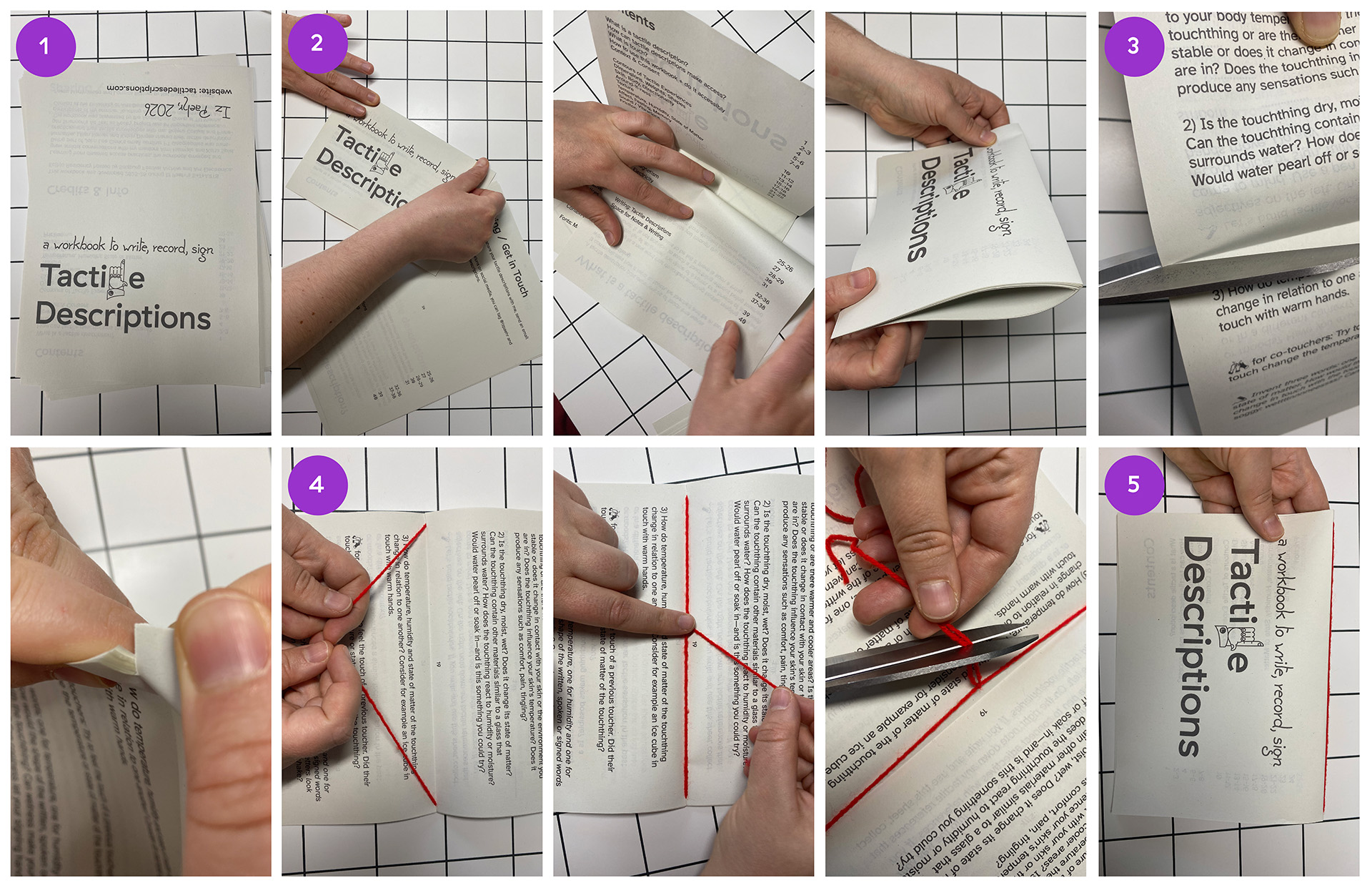
- Print your PDF on A4 paper. Enable double-sided (duplex) printing. Since home printers vary, print one sheet as a test first. Fold it in half: if both sides are readable in the same direction, your settings are correct. If not, change the duplex setting (flip on short/long edge) and try again.
- Each A4 sheet becomes a horizontal A5 spread. Fold the A4 in half away from you (top edge goes towards the back). Crease it firmly. Whenever you have folded a new sheet, insert it into the folded stack of pages. Make sure the page numbers line up. If in doubt, use the digital PDF as orientation.
- For binding with string: At the folded edge (the "spine"), make two small cuts (about 1 cm), one near the top and one near the bottom.
- Thread a string through the cuts and tie it snugly.
- Option B (easier): Just staple along the folded edge with 2 staples.
- Congratulations! You now have a handmade A5 Tactile Descriptions Workbook.